GNSS Link and Receiver-Noise Analysis
1) GPS L1 C/A-code
▪ Satellite Tx power: power to Tx antenna 16.5dBW(±0.3dBW)
▪ Tx antenna gain(Gt): 13.8dBi(±0.4dBi) @ 5º elevation, 15.1dBi(±0.3dBi) @ 50º EL, 11.8dBi(±0.1dBi) @ 90º EL
▪ Range(R): 25150km @ 5º EL, 21410km @ 50º EL, 20180km @ 90º EL
▪ Wavelength(λ): 19.04cm @ 1575.42MHz
▪ Rx antenna gain(Gr): 0dBi @ 0-deg EL, 2dBi @ 50-deg EL, 4dBi @ 90-deg EL
▪ System noise temperature(Ts): Ts = Ta + T0(NF-1) = 316K
- Antenna noise temp.(Ta): Ta = E(Tsky+FBxT0) + (1-E)T0 = 211K
- Clear sky noise temperature (Tsky): 22K(5deg el), 3K(50deg el), 2K(90deg el)
- Antenna front-to-back ratio(FB) = 6dB
- Antenna efficiency(E) = 0.4
- Reference (ambient) temperature (T0): T0 = 300K
- Receiver noise figure (NF) = 1.3dB
▪ Noise power(N0): N0 = kTsB, k = 1.38x10⁻²³ J/K, N0 = -203.6dBW
▪ Carrier(signal) power w/o loss(C'): C' = PtGt(λ/4πR)2Gr, -154.2dBW(90deg)
▪ Additional loss(L): L = 4dB, atmospheric(0.04dB nadir, 0.4dB at 5deg del), polarization mismatch 3.4dB, antenna mismatch 0.2dB
▪ Carrier power at earth(C): C=C'/L = -158.2dBW(90deg) = -128.2dBm
▪ SNR vs C/N:
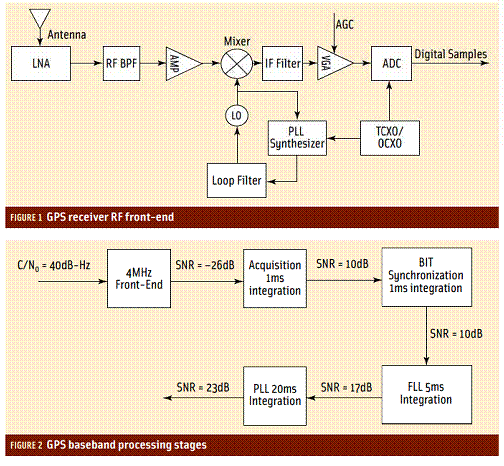
EIRP at ground = -128.5dBm, Thermal noise at input (2MHz C/A code bandwidth) = -108.5dBm, S/N = -20dB at input, C/N = S/N + BW/Hz(dB) = -20 + 63 = 43dB
▪ Nominal signal power = -128.5dBm, power variation ±4dB (difference path and difference viewing angle of each satellite) → C/N (nomical) = 38.5-46.5dB
- C/N = C/N(nominal) - NF(rx) - NF(imp) = 35.5-43.5dB
NF(rx) = receiver noise figure (2dB typ.), NF(imp) = noise due to band-limiting and quantization (1dB typ.)
▪ Final SNR
- Bandwidth after de-spreading = 50Hz, Thermal noise = -154.5dBm, S/N = 26dB at output, C/N = 26 + 17 = 43dB
- Depends on front-end bandwidth, system noise figure, acquisition parameters, tracking parameters
(Another quotation)
▪ GPS L1 C/A-code: satellite EIRP 26.25dW, atmospheric and polarization loss 0.5dB, free-space path loss 184.4dB, EIRP at earth -128.7dBm
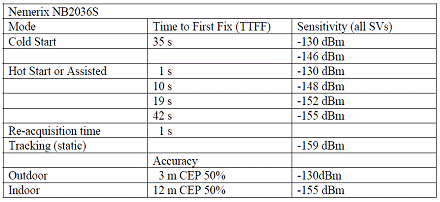
▪ SV acquisition time vs signal level
2) GPS L1 P-code
▪ EIRP specifications: elevation > 5º, atmospheric loss < 2dB, -133dBm RHCP at L1 P code
3) GPS L2 P-code
▪ Satellite EIRP 16.6dW, atmospheric and polarization loss 0.5dB, free-space path loss 182.3dB, EIRP at earth -136.2dBm
4) GLONASS L1 1602MHz
▪ Satellite EIRP 25-27W,
5) SNR determining factors
▪ Antenna gain and noise temperature
▪ System noise figure
▪ Receiver bandwdth (2MHz) and integration time (50-1000Hz): many of the early receivers integrated for 1ms resulting in 1kHz bandwidth.
6) Tracking loop bandwidth issue
▪ Code and carrier PLL: to track time delay, carrier phase, frequency
▪ Loop bandwidth vs dynamic performance tradeoffs in PLL
- Noise proportional to loop bandwidth
- Dynamic tracking error inversely proportional to loop bandwidth
7) Cross correlation
▪ Correlation between different PRN codes (different satellites): -24dB from autocorrelation