GNSS Frequencies and EIRP
1) GPS: -6dB to 0dB variation SV aging and other factors.
▪ L1 C/A code: 1575.42MHz, -158.5dBW EIRP (약 -130dBm) on the Earth's surface outdoor (10-20dB additional loss indoor)
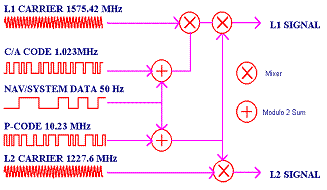
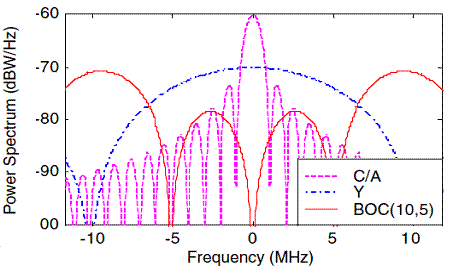
- 1023 PRN chip per one millisecond (chip duration 1us) = 1,023,000 chips/s = 1.023MHz → 2.043 MHz bandwidgh
- 32 different and pre-defined sequences assigned to 32 GPS satellites
- Autocorrelation = 2n-1 = 1023, cross correlation < 2(n+2)/2+1=65

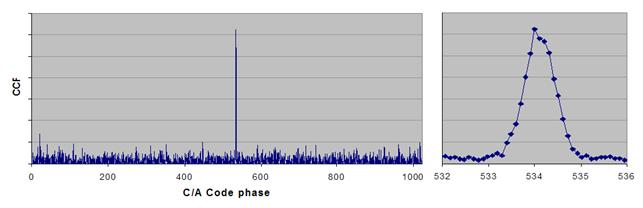
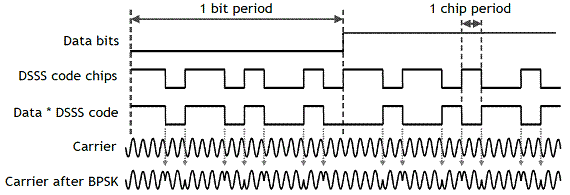
- BPSK modulation
▪ L1 P(Y) code: 1575.42MHz, -133dBm
- 6.1871x10¹²/bits long, repeats only once a week → 10.23MHz/s (0.1us chip duration) PRN code. The extreme code length increases its correlation gain and eliminates any range ambiguity within the solar system.
- Y-code: encrypted (by modulating it with W-code) for anti-spoofing(AS) purpose. AS-module required for each receiving channel. Since Jan. 31, 1994 P-code is only transmitted as Y-code
- P-code carrier in quadrature phase with the C/A carrier.
▪ L2 P(Y) code: 1227.60MHz, -135dBm
- 10.23MHz PRN code
- Using L1 and L2 frequencies: redundancy, increased jamming resistance, ionospheric delay extraction.
2) GPS, modernized
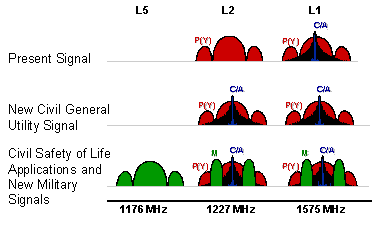
▪ Summary: a) EIRP increased, 2) pilot carrier for improved tracking, 3) longer codes for improved cross-correlation performance and for increased processing gain, 4) binary-offset carries modulation for better multipath perform.
▪ L1C: 1575.42MHz,-157dW, pilot carrier for improved tracking, L1 C/A backward compatibility, to enable GNSS interoperability, 24 sat. by 2021.
▪ L1M: 1575.42MHz, -160dBW, direct locking to M-code (current: C/A code locking -> P(Y) code locking). whole Earth beam(-158dBW)/spot beam (-138dBW). binary-offset carrier modulation for better multipath perform., 24MHz bandwidth, 4 effective data channels
▪ L2C: 1227.60MHzz, -157dBW, CM(Civilian Moderate length code). 10,230bits, 20ms period, 1.023Mbps; CL(Civilian Long length code). 767,250bits, 1500ms period, 1.023Mbps, 24dB greater correlation protection than L1 C/A, -2.3dB power decrease, higher stand-alone accuracy with ionospheric correction, 24 sat. by 2016.
▪ L2M: 1575.42MHz, -160dBW, direct locking to M-code (current: C/A code locking -> P(Y) code locking). whole Earth beam(-158dBW)/spot beam (-138dBW). binary-offset carrier modulation for better multipath perform., 24MHz bandwidth, 4 effective data channels,
▪ L5(Safety of Life): 1176.45MHz, -154dBW, 10dB increased processing gain, 10 times longer code, operational since 2010-6-28, improved signal structure for enhanced performance, precision loc. for transport./avi., 24 sat. by 2018.
|
Link Designation |
Name |
Freq. (MHz) |
Code |
Reference |
|
L1 |
Everybody |
1575.42 |
C/A, WAAS, P(Y) |
IS-GPS-200D |
|
L1C |
Civilian Quasi-Zenith Satellite System |
1575.42 |
BOC(1,1), TMBOC, CNAV-2 |
IS-GPS-800 |
|
L1M |
Military |
1575.42 |
M MNAV |
|
|
L2 |
Military |
1227.60 |
P(Y) |
IS-GPS-200D |
|
L2C |
Civilian |
1227.60 |
CM, CL, CNAV |
IS-GPS-200D |
|
L2M |
Military |
1227.60 |
M, MNAV |
|
|
L3 |
Nuclear Detonation Detection |
1381.05 |
|
|
|
L4 |
Ionospheric Correction |
1379.913 |
|
|
|
L5 |
Safety of Life |
1176.45 |
I5, Q5, CNAV |
IS-GPS-705 |
3) Galileo
▪ S. Korea joined 2006-1-12
▪ EIRP relative to L1 C/A: L1 (+5dB), L5/E5 (+8dB), E6 (+5dB), binary-offset carrier -> stronger resilience to multipath.
4) GLONASS
▪ L1 1592-1615, L2 1237-1257, L3 1194-1209; GLONASS modernization under way.